The “Does Any of This Actually Work” Issue
I’ve never understood why the universal symbol for AI is basically the Pittsburgh Steelers’ logo, but every product launched by pretty much every vendor in the past couple of years has those three enigmatic triangles located somewhere in the product design, because today, every product has to have AI.
After all, companies are projected to spend on AI solutions in 2026 alone, which (to give you a sense of this awe inspiring scale) is the equivalent of the entire GDP of Brazil, the value of the entire oil reserves of Saudi Arabia, or approximately four annual enterprise licenses to LinkedIn Corporate Recruiter Pro.
The promise is simple: artificial intelligence directly correlates with improved productivity and business outcomes, creating significant time and cost savings by automating the tedious, highly repetitive and highly manual functions and thus, freeing up professionals to focus on the customer and market facing interactions that matter most.
This makes for a great story. But as we’re approximately four years into the generative AI era – with the first open model of Chat-GPT debuting during the last World Cup – which is plenty of time to generate the data necessary to check the actual receipts and see whether or not it’s a true story – particularly when it comes to talent acquisition.
Turns out, talent acquisition is currently suffering from a multi-billion-dollar disconnect. In the frantic race to automate hiring, organizations have successfully scaled their budgets, but not their breakthroughs.
The line between simply buying an AI license and actually rewiring a recruitment workflow has become a costly chasm, proving that throwing capital at an algorithm doesn’t solve a human resources crisis. So, four years into the AI era, what tangible benefits, exactly, has AI delivered, and which are stuck somewhere in the “trough of disillusionment” phase of the tech hype cycle?
Let’s take a look.
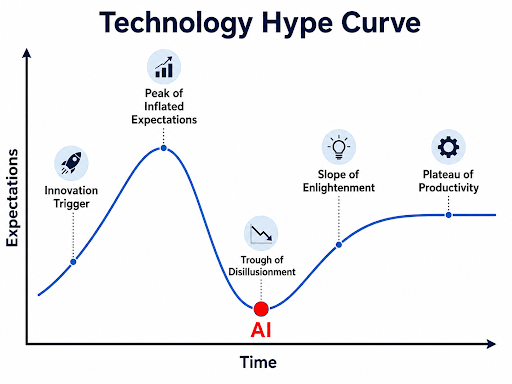
Productivity: real at the desk, missing on the spreadsheet
Let’s lead with the good news, because there’s plenty.
Adoption nearly doubled YoY, jumping from about 26% percent of HR organizations leveraging AI tools to a robust 43%, per SHRM’s recent data (which still seems low); similarly, tons of recruiters will tell you, at least anecdotally, that the tools really do carve hours off the soul-deadening parts of the job, the stuff none of us signed up for, like mass resume dispositioning or high volume prescreening.
The bigger picture, though, remains a foggier – and the results are decidedly mixed. Let’s start with the big one: it’s conventional wisdom (bordering on hackneyed cliche) that talent acquisition must align with bigger business and bottom line objectives – an alignment that starts at the C-Suite.
This represents yet another glaring expectation gap executive management and people leaders; outside of the talent function, executives seem decidedly less bullish on AI. In fact, a recent National Bureau of Economic Research study of roughly 6,000 C-Suite executives found that most of them see almost no operational impact from AI.
That same study suggested that the average user of enterprise AI solutions only logged in to these tools about 90 minutes a week (one can assume they spent a fraction of this actually using these tools), and fully one quarter of all workers weren’t actually bothering to even log into these tools at all.
This is actually evidence of a pretty longstanding phenomenon called the Solow productivity paradox (yes, I’m old, and yes, I’m a giant nerd), which observed that the more ubiquitous computers became in the workplace, the less obvious their empirical implications actually were.
Brookings makes the same careful case, pointing to at least one controlled study where AI made experienced developers slower even while they swore it was speeding them up. As an economist quoted in the article pointed out:
“AI is showing up everywhere. Except in actual economic data.”
One could argue that the same is true about recruiting analytics and hiring outcomes, too.
Reflecting on Quality of hire: the Stanford prism experiments
Let’s take a look at the most classic, and arguably the most Quixotic of recruiting baselines: quality of hire. Now, most of us know that you can’t measure a subjective concept, particularly one that’s predicated on correlation instead of direct causation.
But that fact hasn’t stopped TA teams from spending the last two decades searching for this Holy Grail of recruiting and hiring, even if they won’t know if a hire is regrettable or not (forget “good,” since the first year aggregate churn rate for US workers hovers above 50%) for at least 12-18 months, by which point they’ve already had a longer tenure than most (which, one assumes, counts as good). T
Volume, though, is a different story – and as far as these metrics go, it’s growth basically hockey sticks. Joveo’s own Recruiting Benchmarks Report 2026 found applicant volume swelled as much as 9x over three years for many roles.
The thing is, though, more applications in has not meant more offers out. Anyone glaring at a req with four hundred unqualified applicants already knows the dirty secret that volume is a poor proxy for value.
The clearest proof AI improves relative quality of hire comes from a Stanford field experimentwhich randomized about 37,000 applicants for a junior developer role. The group screened via AI tools were ultimately selected for final human interviews at a rate of around 54%, or around 20% higher than for resumes manually reviewed by a recruiter (34%). Furthermore, recruiters leveraging AI required 44% fewer interviews to drive a final hiring decision.
Those proof points alone sound like they’re easily worth the investment – right up until the footnote that suggests these outcomes are less evidence of efficiency gains for recruiters and more evidence that they’re simply passing along these efficiencies to candidates themselves.
The candidate experience and AI are totally ops.
Even though AI and the candidate experience aren’t necessarily antithetical, the Stanford study – while relatively limited in scope, and confined only to knowledge workers in the tech industry – found that for every one hour of time recruiters actually save, candidates were required to complete 45 hours of unpaid work, since the experiment design required every applicant sit through a 40 minute long AI-driven prescreen.
The research notes that without these rigorous automated assessments codified in the hiring process, then demonstrating any differences in recruiting outcomes would be impossible to prove – so, rather than remove friction from the hiring process, AI enforces it, by design and by reporting necessity.
So much for that whole “candidate experience” thing we talked about ad nauseum for years, before high touch was canonically displaced by high tech, and automation won the war over personalization.
Of course, applicant side AI has already foiled many employer related tools and technology, with copycat resumes and prompt interjections turning the funnel into a war of attrition. Any victory will be pyrrhic at best; at worst, bots will be effectively stack ranked and assessed by other bots, and the whole “human” part of HR will become nothing more than an ironic punchline.
OK, maybe it’s too late for that. But if you sign up for membership today, you too could be the proud owner of a SHRM Boggs bag and professional certification that’s about as valuable as the ones that purportedly demonstrate AI proficiency.
Don’t hate the player, hate the platform.
AI and ROI: A False equivalency.
Here is an extended version that expands on the hidden costs and the candidate-side AI arms race, keeping your sharp, analytical tone intact:
Vendors love quoting cost-per-hire cuts of 20 to 40 percent, and in high-volume lanes, like retail or logistics, those numbers are sometimes even real. When success is measured purely by how fast a bot can auto-filter an application or schedule a baseline interview, automation delivers. Software vendors take these highly transactional edge cases and market them as a universal cure-all for enterprise recruiting.
But the wheels come off when looking at aggregate outcomes. According to SHRM’s benchmarking work, average cost-per-hire and time-to-hire have both climbed over the past three years, which is exactly when generative AI flooded the stack.
If these tools were the financial panaceas promised in glossy sales decks, industry-wide metrics should be plummeting. Instead, organizations are paying steep enterprise licensing fees for AI overlays while watching their efficiency numbers degrade. The hidden overhead of tech debt, clunky integrations, and constant algorithmic troubleshooting is quietly cannibalizing any localized savings.
Correlation isn’t causation, and I’m not blaming the bots. I’m just noting that the line is running the opposite way from the slide. The irony of the current landscape is that candidates adopted GenAI just as fast as employers, flooding job boards with a relentless stream of perfectly optimized, bot-written resumes. Instead of liberating recruiters, AI has buried them in synthetic noise, requiring more human intervention, more manual vetting, and ultimately more capital to find an actual human fit.
We bought the technology to streamline the funnel, but we’ve engineered a costlier, more complicated process instead. Classic.
Don’t take our word for it
Most of the loudest opinions about AI in hiring come from the companies selling AI for hiring. Even the one sponsoring this newsletter. With that in mind, here’s what people with nothing to sell or any real agenda are saying about whether or not AI is really delivering as promised.
You can’t spell DEIB with “AI.” In the first large-scale look at hiring algorithms running in the wild, researchers tracked 3.4 million applicants and found that 26 percent of Black applicants and 15 percent of Asian applicants hit roles where the algorithm discriminated against their group. The real nightmare is what they call systemic rejection, where because employers lean on the same handful of vendors, one screen-out quietly predicts the next; a single bad score tails you from company to company like a credit report nobody told you about.
Job seekers are voting with their feet. In a recent report, Fortune found that nearly four in ten people have ghosted a hiring process the second it demanded an AI interview, and another 12 percent say they’d bolt if forced into one. About 63 percent have already been interviewed by a machine. The blunt takeaway was that the cost of all this automation lands hardest on the folks who can least afford it. Or “frontline workers,” as we like to call them.
It’s the economy, stupid. Economists at the New York Fed combed through job postings and decided AI isn’t the main reason hiring has cooled, since the dip in AI-exposed openings started before ChatGPT even landed, and most firms say they’re retraining people instead of cutting them. Let’s hope that training involves battling cyborgs running off of a hive mind to keep our inevitable robot overlords at bay – for now.
The damage is done. In an early-June piece, the Atlantic argues that AI has already broken the job market rather than merely threatening to, conjuring that surreal standoff where job seekers can’t get hired and employers swear they can’t fill roles at the very same moment. This doom spiral looks set to continue for the indefinite future.
The bottom line
AI doesn’t actually improve recruiting outcomes at scale; instead, it accelerates narrow, highly managed tasks, and only when you dedicate resources to actively monitoring and optimizing these outputs (“agentic” should, however, eliminate this requirement, not to mention any modicum of transparency – but “take our word for it” is always a successful foundation for a TA Tech partnership, obvi).
Any efficiency gained will only be provable via correlation (and if we’re going that route, reading this newsletter is the reason your organization’s AI investment is outperforming the market), and they remain largely siloed behind the black box of dozens of disparate HR systems, while the broader organization inherits the technical deficit and inflated costs of implementing AI in TA. Leaders love it when cost centers cost more – this is definitely the quickest path towards that seat at the table.
Look. If you’re waiting for a structural breakthrough to justify your current enterprise software spend, you’ll be here for a while (say hello to Godot, while you’re at it). As we’ve seen, early data seems largely unequivocal in linking AI adoption to higher costs and the endemic enterprise productivity plateau.
If you’re in TA, and want to use AI to gain a competitive advantage, here’s the best short term strategy: stop buying more AI. You don’t need to expand your stack, or add more AI tools or technologies; rather, focus on consolidation instead, looking at ways to eliminate specious point solutions or duplicative capabilities.
Audit every current and prospective “AI” technology partner you currently work with, demand empirical evidence of financial impact, ROI or improved hiring outcomes, and cancel the contract of every vendor who can’t demonstratively prove that their solution isn’t just creating an even bigger problem (spoiler alert: it probably is).
The most definitive metric of TA this year won’t be how many AI tools you deployed; it’ll be how much AI you managed to cut, consolidate or avoid purchasing all together. That’s a way more compelling business case for the C-Suite than, say, quality of hire.
Want to see which side of the two labor markets your roles are sitting on? The fullJoveo Recruiting Benchmarks Report 2026 breaks the split down by occupation and state.Because talent intelligence beats artificial intelligence, and always will.
Until next month, happy hiring,
Matt Charney on behalf of Joveo