AI Interviewing: Greatest Strengths and Weaknesses
The monthly read for talent acquisition leaders who’d rather hear it straight than see it spun. This month: the interview – one of corporate America’s most expensive and least effective rituals – is finally getting reinvented and reimagined. Sort of.
The Lede: The Interview Is Finally Getting an Upgrade
The job interview has become so entrenched in the recruiting process that we rarely stop to consider how genuinely weird this corporate ritual actually is. It’s performative, largely scripted, and, if we’re being honest, mostly meaningless. Many hiring managers are still leaning on behavioral questions taken straight from the Eisenhower era, combined with a heavy dose of “gut feelings” and vibes.
Sure, some teams layer in structured scorecards, panel interviews, mandatory bias training. All reasonable Hail Marys. But the foundation of nearly every hiring decision still comes down to vibes.
You might know it as “culture fit.”
It’s the most important determinant of who gets the job and who gets a templated rejection email, if they’re lucky. Employers have known for decades that interviews aren’t predictive of future performance. The research has been saying this for years.
Statistically, you might as well flip a coin; the outcomes are roughly comparable. And yet here we are, still asking people to “tell me about a time when…” as though that’s ever revealed anything useful about whether someone can actually do a job.
The good news (and there actually is some, believe it or not) is that vendors finally have a way to address the judgment errors and confirmation biases that are basically the unavoidable byproduct of two people with competing agendas making awkward small talk for 45 minutes.
Enter AI interviewers. Here’s what every TA pro needs to know to get caught up on what’s new – and what’s next – in one of the hottest categories in work tech today.
This Month’s Required Recruiting Reading
- Structured Interviews Still Beat Gut Feel (By a Lot)
Fact: structured interviews outperform unstructured ones by a significant margin when predicting job performance and role fit.Dozens of peer-reviewed studies have reinforced this for decades. When an interview is an open-ended, casual conversation without scoring criteria, it produces inconsistent and biased outcomes – the exact thing recruiting claims to be solving for.
Given that the average cost of a bad hire sits somewhere around $5,000-$7,000, traditional interviews have become an opportunity cost most employers can’t justify and somehow keep paying anyway.
The latest research from the National Bureau of Economic Research looked at how AI systems are standardizing evaluation criteria across hiring workflows. The findings are pretty clear: humans aren’t great at interviewing. Fully automated systems on their own aren’t either. But when high-touch meets high-tech, the predictive success of job-related interviews increases meaningfully.
Humans forget questions. Most interviews are completely improvised, which eliminates any possibility of data-driven decision making. The hiring manager asks whatever comes to mind, the job seeker responds with anecdotal answers, and the decision comes down to personal preference – more commonly referred to as bias. AI interviewers don’t eliminate bias (they introduce algorithmic bias by design, which is its own conversation worth having).
But they’re genuinely good at the thing human hiring managers consistently fail at: asking the same questions, collecting the same signals, evaluating every person using the same criteria. Every single time.
Consistency isn’t as exciting as disruption. But the data suggests it matters just as much.
Read more:Artificial Intelligence and the Labor Market,National Bureau of Economic Research
- The AI Job Apocalypse Still Isn’t Showing Up in the Data
AI isn’t eliminating jobs at scale, despite being a remarkably convenient scapegoat for the wave of tech industry layoffs that probably would’ve happened regardless. What it is doing is quietly reshaping the fundamentals of who gets hired, and who never even makes it that far.
The Anthropic labor market report is refreshingly rational here. Limited evidence exists to support widespread unemployment, but there’s early and suggestive evidence that hiring is already slowing the most in roles most exposed to AI displacement, with early-career workers bearing a disproportionate share of the impact.
AI doesn’t eliminate existing jobs so much as it restricts access to them – particularly for workers without significant experience or expertise. If you’re a recent grad, that’s probably not the reassurance you were hoping for.
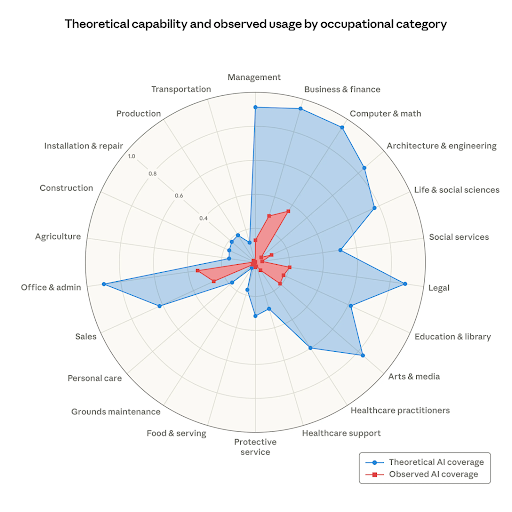
In this report, Anthropic introduces the concept of “observed exposure,” which is basically measuring not what AI could theoretically automate, but what it’s actually doing in real workflows, right now.
A significant portion of knowledge work is already being augmented, especially in programming, customer service, and data analysis. Recruiting, interestingly, looks relatively safe. Roles requiring learning agility, situational adaptation, and interpersonal communication are among the least likely to see near-term displacement.
The implication for hiring is pretty direct. If AI can assist with a growing share of job tasks, the criteria for evaluating human workers undergoes a fairly seismic shift. Chemistry, pedigree, and personality become less reliable as proxies for performance. Consistency and signal clarity become the premium. Unstructured interviews, which leverage different questions, different interpretations, and outcomes influenced by variables as seemingly unpredictable as what kind of mood the hiring manager is in – just aren’t equipped for that world. And never really were, frankly.
If the hiring process still runs on informal conversations and likeability, that’s less strategy than professional liability.
Consider yourself warned.
Read more: Labor Market Impacts of AI – A New Measure and Early Evidence, Anthropic
- AI Interviewers Are Having a Moment. The Market Isn’t Ready for It.
One of the more honest observations, somewhat buried in the recently published (and comprehensive) Category Compass on AI Interviewers from Kyle & Co is pretty intuitive, at least if you work in TA today: vendors are shipping capability faster than buyers can meaningfully evaluate it.
That’s not talking smack; ultimately, the most useful framework for understanding where this category actually is versus where the sales decks say it is.
The report benchmarks a dozen of the top AI interviewer solution providers. The goal isn’t to provide neat rankings or a tidy list, but to help talent leaders figure out which solution fits their specific context before they’re stuck with buyer’s remorse and a messy pilot to explain to their CFO.
Smart approach, especially for a category most practitioners still can’t clearly define. The TL;DR: adoption is real, but largely experimental. Buyer readiness lags behind vendor capability, and the strongest outcomes come from improved structure and consistency – not full automation or expanded feature sets.
If you watched the “big data” hype cycle in 2016 or “social recruiting” in 2012, this should feel familiar. It’s not going to transform recruiting overnight. It’s going to reshape it gradually, and mostly in ways that only become obvious in retrospect – usually after someone’s already spent six figures on the wrong platform.
The report also draws a distinction more analysts should make: AI interviewers aren’t transcription tools or rebranded chatbots bolted onto scheduling workflows. They’re semi-autonomous conversational agents capable of dynamically generating questions and follow-ups based on role context and candidate responses in real time.
Whether buyers understand that distinction before signing a contract is, unfortunately, a different matter entirely.
The truth is, just like interviews themselves, there’s no one size fits all approach to selecting and implementing an AI Interviewer into an existing hiring process. Instead, success depends on alignment between use case and capability, automation and organizational maturity, innovation and governance.
Treating vendors as interchangeable is the kind of RFP process that ends with failed pilots and really awkward quarterly business reviews.
Read more: Category Compass – Navigating AI Interviewers, Kyle & Co
- The Bottleneck Moved. Most Recruiting Teams Haven’t.
There’s a number in Joveo’s 2026 Recruiting Benchmarks Report that should be giving people pause. Applicant volume in certain occupational categories exploded 9x between 2022 and 2025. Nine times. That’s a structural anomaly, not a trend, but most teams are still acting like it isn’t happening.
Most talent acquisition teams are still organized around the assumption that sourcing is the hardest part of the job. If you find the people, conventional wisdom goes, the rest takes care of itself. What Joveo’s data actually suggests is that “the rest” isn’t taken care of: it’s largely ignored. The constraints that used to live at the top of the funnel have moved downstream; it’s just that a lot of organizations either haven’t noticed, or, more likely, haven’t wanted to.
Recruiters in high-volume roles usually hired from the first wave of applicants and never got to the qualified job seekers buried deeper in the queue. That’s a screening failure. The talent is there. The infrastructure to surface it isn’t. That’s a more uncomfortable truth than “there’s not enough talent out there” – because it’s operational, not market-driven. The problem lives inside the building.
The ripple effects are pretty lacking in any sort of subtlety. Employers responded by raising experience requirements. Tech job postings asking for five or more years of experience climbed from 37% to 42%.
This sounds reasonable, until you realize it’s quietly narrowing entry points for early-career workers while inflating cost-per-hire simultaneously. Scarcity thinking in an abundance environment is a classic logical fallacy and, more often than not, a self-inflicted wound that, in recruiting, gets blamed on the labor market.
Joveo’s data points to mid-funnel orchestration as the next real battleground in talent acquisition. Screening speed, interview scheduling, structured evaluation at scale. That is, after all, where the future competition for quality hires will actually be decided.
The teams that figure out how to move qualified people through faster, without defaulting to whoever applied first, are probably the ones that start winning on quality-of-hire rather than just time-to-fill.
Read more: 2026 Recruiting Benchmarks Report, Joveo
Feature: The Mid-Funnel Finally Gets Its Moment
Joveo launched its own AI Interviewer at Unleash last week, and the timing isn’t accidental. Six weeks after publishing benchmark data showing an exponential spike in applicant volume, they brought a product to market that’s a direct response to the operational breakdown demonstrated by their own data.That’s either a remarkable coincidence or a very well-planned press cycle, if we’re being honest.
The product conducts automated, structured interviews across web, phone, and WhatsApp, asking role-specific questions, dynamically probing responses, and pushing summaries, transcripts, scores, and hiring recommendations directly into the ATS. It addresses the thing that’s been quietly breaking inside most high-volume recruiting operations: the pipeline, not the process.
Worth noting: what Joveo doesn’t claim is honestly just as telling as what it actually does. The positioning deliberately frames the use case around consistency and fairness, without replacing human judgment.
Given the regulatory scrutiny AI hiring tools are currently attracting from multiple directions, that’s probably the right instinct. Frankly, this is a much more defensible product story than “AI will handle everything, so just chill.”
The bottleneck in the hiring process has moved from the top of the funnel to somewhere squarely in the middle. Joveo has solved for the first problem for years. Now they’ve built for the second. It’s a smart move that’s also long overdue, too.
Read the official announcement: Joveo Launches AI Interviewer to Help Recruiting Teams Manage Record Applicant Volume
Best Recognize: Joveo Named a Best Place to Work
Forbes named Joveo one of America’s Best Startup Employers for 2026, which is the kind of thing that usually gets filed under “nice PR, moving on.” And sure, it’s technically a press release. But there’s a signal worth paying attention to underneath the self-congratulation.
The ranking pulls from more than 20,000 companies and evaluates employer reputation, employee satisfaction, and company growth, which means it’s at least loosely correlated with organizations that aren’t quietly falling apart internally. In HR tech, that’s not nothing. The graveyard of VC-funded recruiting platforms that burned through headcount as fast as they burned through runway is long and distinguished.
What’s more interesting is the timing. Joveo lands on this list alongside names like Otter.ai, Cribl, and Kairos Power. The common thread is unusually fast growth that hasn’t fully destroyed the culture yet. That’s a narrow window. Most companies don’t stay in it very long.
These awards normally sit somewhere between BS and PR, served with a side of vanity. Sometimes, though, they’re a leading indicator. And anyone who’s spent time with the Joveo team will tell you this one’s well deserved – the Glassdoor reviews don’t lie.
Read More: Joveo Named To Forbes America’s Best Startup Employers of 2026
The Close: Interviews Aren’t Sacred. They’re Just Old.
“Tell me about yourself” is basically the talent acquisition version of commenting on the weather. It’s what TS Eliot might’ve called full of sound and fury, signifying nothing; which is, honestly, an accurate description of most traditional job interviews. And yet, we’ve built an entire profession around them.
Go figure.
AI interviewers, while still a newer category, have already consistently proven one seemingly universal truth: even the most automated process still needs human judgment as the final call. Nobody’s arguing otherwise.
What AI is providing is the empirical evidence, structured data, and process standards that interviews have always lacked – and exposing, in the process, just how arbitrary and ineffective the traditional interview has always been. Which is less a revelation and more a confirmation of what most honest practitioners already suspected.
The early results are mixed. The technology is ahead of the buyers. The governance is lagging. The candidate experience is uneven. All true. All will look different in 18 months, the same way every prior wave of HR tech looked different once the hype burned off and actual use cases crystallized. Or didn’t.
The alternative to figuring this out isn’t comfortable, though. Regrettable hires, longer times-to-fill, and no ability to predict performance. Statistically speaking, the coin flip isn’t a metaphor – it’s basically the current baseline for unstructured interviewing.
If you’re not thinking seriously about where AI interviewing fits in your hiring process, the five-year plan probably needs some work.
Happy hunting.
Matt Charney for Team Joveo
Recruiting Unfiltered is published monthly by Joveo. Forward this to someone in talent acquisition who needs to hear it.