
When your CEO reads headlines about a cooling labor market and questions why time-to-fill hasn’t improved, what’s your response? The truth is, the market they’re observing isn’t the one you’re navigating. We’re no longer operating in a singular labor market; instead, two distinct markets demand your attention, and understanding the right hiring benchmarks for 2026 is crucial as you likely contend with both simultaneously.
Our Recruiting Benchmarks Report (2026) delves into this critical divergence. Drawing on Interactive Insights data from 16 occupations across all 50 states, it moves beyond generalized averages that fail to capture real-world complexities and, instead, illuminates precisely where hiring pressures have intensified and what these shifts could mean for your immediate strategic decisions.
More Applications, Not Necessarily Better Hires
Between 2022 and 2025, application volume per job surged by up to ninefold. Software developer roles, in particular, experienced an overwhelming influx, attracting far more applicants than recruiters could realistically screen. You’re likely familiar with the catalysts behind this phenomenon: Easy Apply features streamlined submissions, AI tools enabled candidates to apply to hundreds of roles within hours, and volume-focused sourcing platforms delivered exactly what they promised – maximizing applications but not necessarily quality.
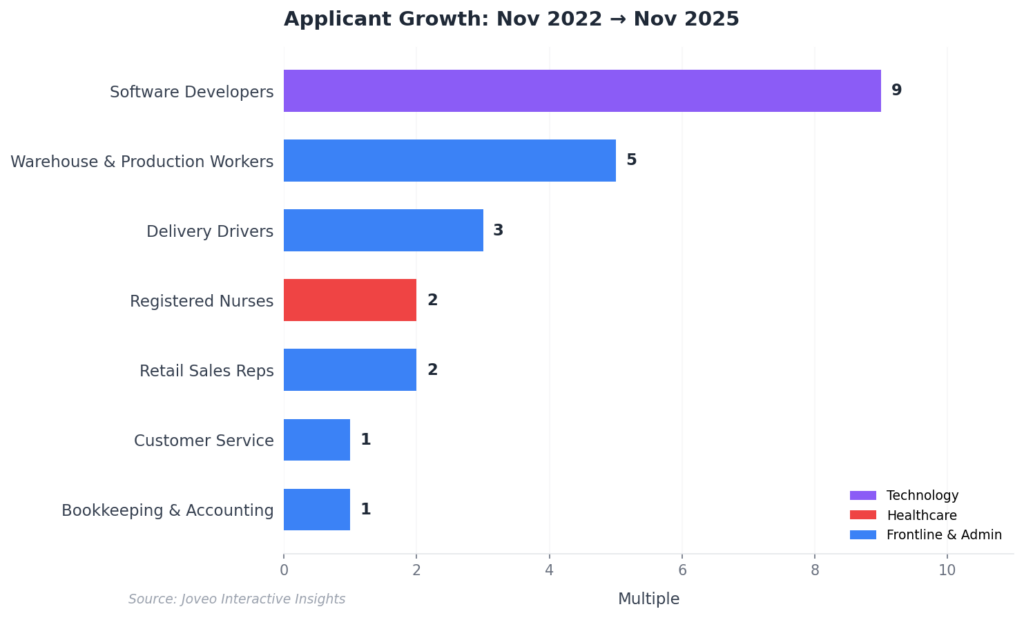
While cost-per-application (CPA) decreased in many roles, the hiring process itself didn’t become easier.
For software roles, Easy Apply drove CPA as low as $3, yet a five-page application form could push it closer to $40. This twelvefold disparity highlights a crucial point: CPA alone doesn’t capture the dynamics within your pipeline. Under pressure, many recruiters extended offers from the initial wave of submissions, often overlooking resumes beyond the first few dozen. Applicant #87, potentially the ideal candidate, might have been missed entirely.
The bottleneck has shifted from sourcing to screening. If CPA remains your primary metric for high-volume roles, you might be mismeasuring your efforts.
Supply-Constrained Roles Remained Unchanged
Conversely, while some recruiters were inundated with applications, others observed the headlines about a “cooling labor market” with skepticism, wondering where this supposed cooling was occurring. For critical roles such as nurses, electricians, and CDL drivers, candidate supply remained stagnant. Demand showed no signs of easing, and time-to-fill metrics held firm.
Data from 2025 reveals that RN postings reached nearly 1.4 million. When adjusted for employment, this translates to approximately 49 job postings per 100 employed nurses – marking the highest demand-intensity ratio identified in our study. Furthermore, credentialed roles incurred higher costs; the median CPA for RN roles with two-page applications was $9.73, more than double that of customer service positions.
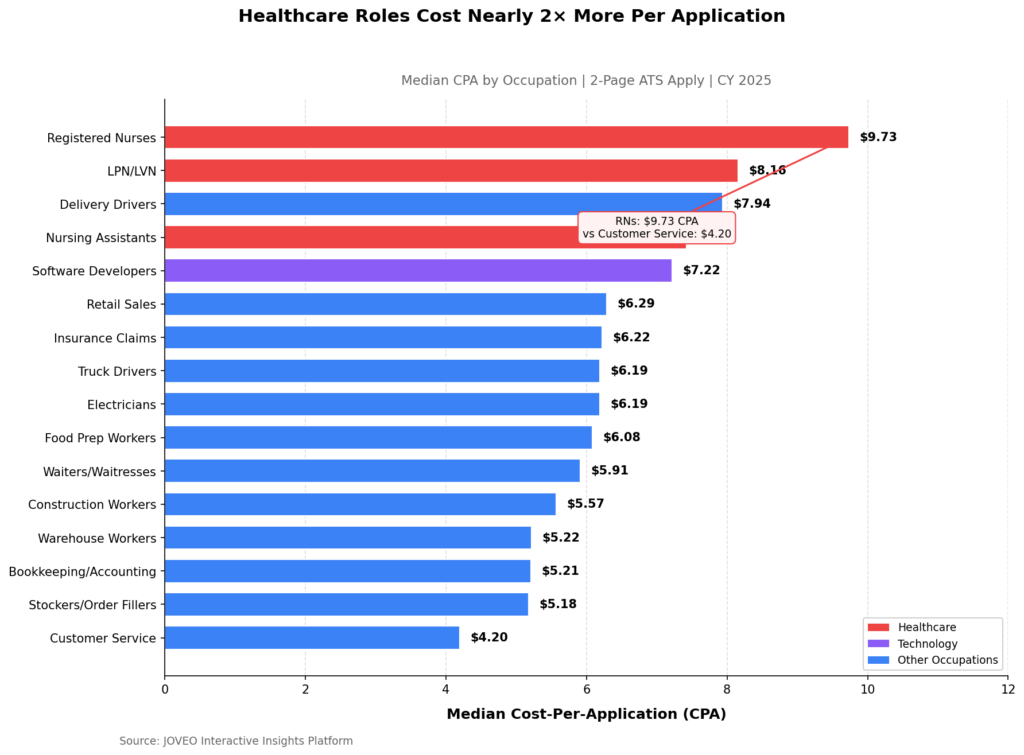
The reality is that macro-economic conditions do not spontaneously generate licensed professionals. Training pipelines operate independently of quarterly labor reports. You simply cannot hire talent that does not exist. This is not a sourcing challenge; it is a fundamental supply constraint. Applying high-volume recruitment tactics to supply-constrained roles will only inflate costs without yielding improved results.
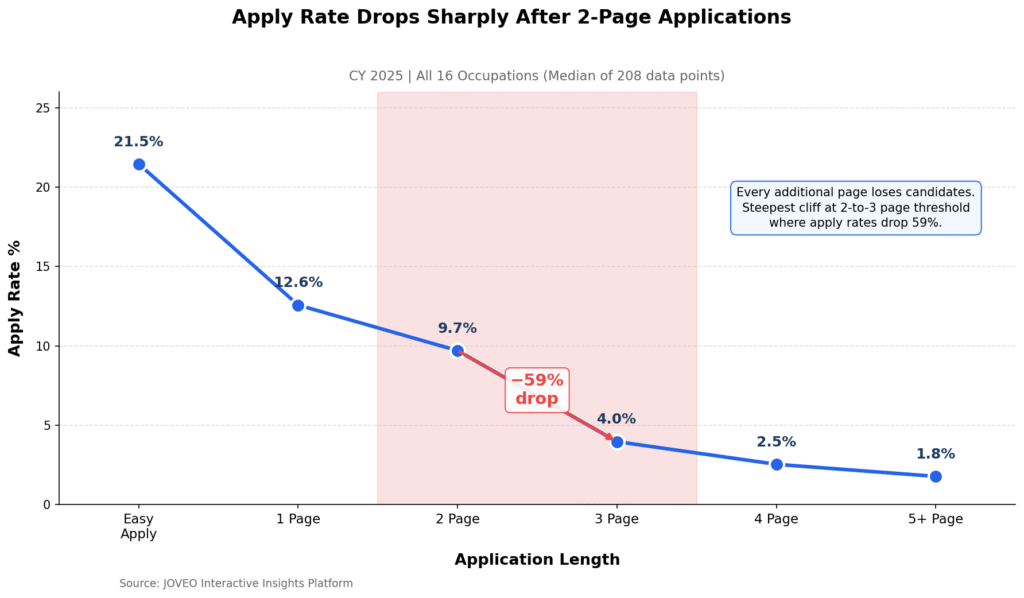
Moreover, friction exacerbates the problem: across all 16 occupations studied, apply rates plummeted by 59% when application forms expanded from two to three pages. In roles where every qualified applicant is crucial, even minor obstacles can deter potential candidates.
The Unintended Consequence: Experience Creep
This is where the two distinct markets intersect. In high-volume roles, experience requirements subtly escalated. This wasn’t due to a fundamental change in job responsibilities, but rather because employers suddenly found themselves with an abundance of options. When faced with 150 resumes for a single opening, and a third of those candidates possess three or more years of experience, it becomes natural for hiring managers to prioritize those with established track records. What began as preferences quickly solidified into filters, and those filters, in turn, became policy.
In the technology sector, roles demanding five or more years of experience increased from 37% to 42%, while postings requesting two to four years of experience declined. Entry-level opportunities contracted, not because companies ceased needing junior talent, but because the prevailing market conditions allowed them to be more selective. Concurrently, voluntary attrition returned to pre-pandemic levels, meaning fewer individuals were leaving their jobs. This reduction in turnover, coupled with the surge in applications for available positions, further incentivized hiring managers to filter candidates based on experience.
While this approach might seem logical in isolation, as a systemic pattern, it introduces significant risks. It fosters a hiring model that implicitly drives up costs, impedes pipeline development, and ultimately restricts long-term organizational adaptability. Experience creep is not a deliberate strategy but a reactive coping mechanism. And it is accumulating a talent debt that will inevitably come due.
One Process Cannot Serve Two Markets
Many organizations continue to apply a uniform hiring process across roles that are fundamentally dissimilar. The same tools, the same metrics, and the same expectations are being applied indiscriminately. This approach is demonstrably ineffective.
For high-volume roles, success hinges on superior screening mechanisms, not merely increased sourcing efforts. This necessitates structured evaluations, intelligently designed friction points early in the funnel, and metrics that genuinely reflect candidate quality and conversion rates, rather than solely focusing on cost.
Conversely, for supply-constrained roles, the primary objective is attraction. This requires targeted outreach, strategic brand investment within specific talent markets, and candidate experiences meticulously designed to eliminate all unnecessary friction. Our report meticulously details both of these distinct approaches, providing hiring benchmarks for 2026, tailored to each occupation.
Empowering Your Strategic Decisions
The next time your leadership team is looking for answers when it comes to persistent time-to-fill challenges, this report equips you with concrete, data-driven insights. It clearly delineates where application volume surged, where it remained unchanged, and why relying on macro averages will not inform an effective talent acquisition strategy.
The full 2026 Recruiting Benchmarks Report is now available. You can read the full report here.